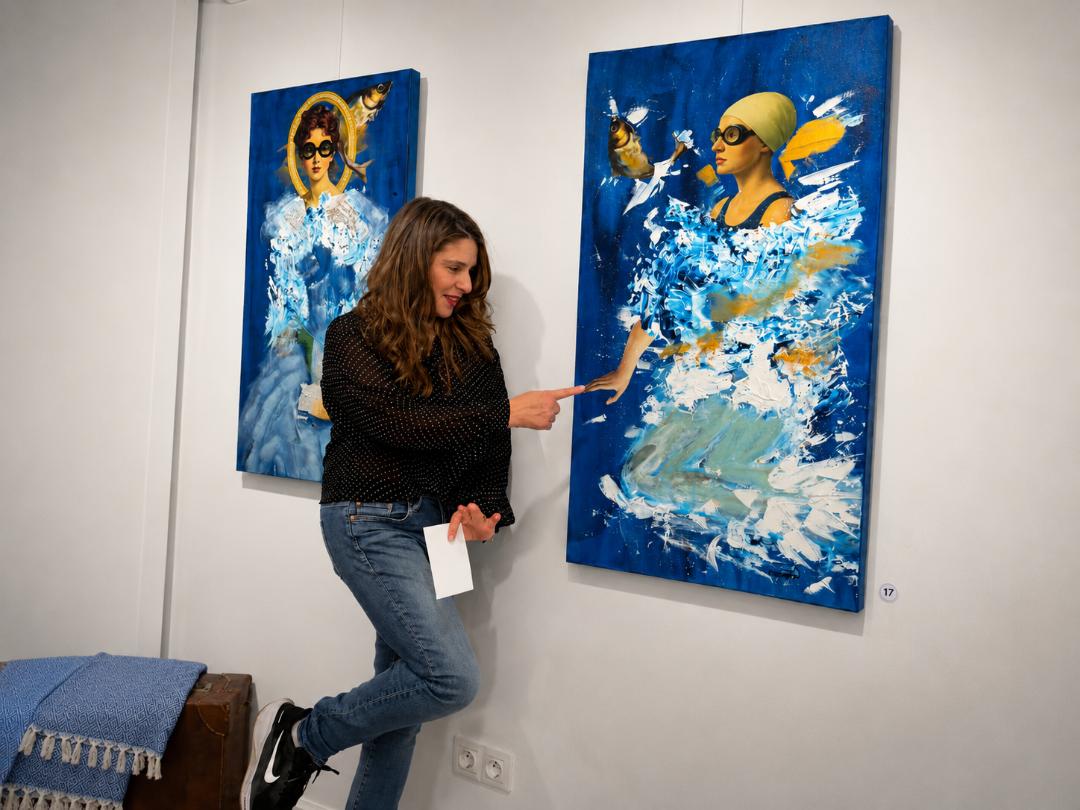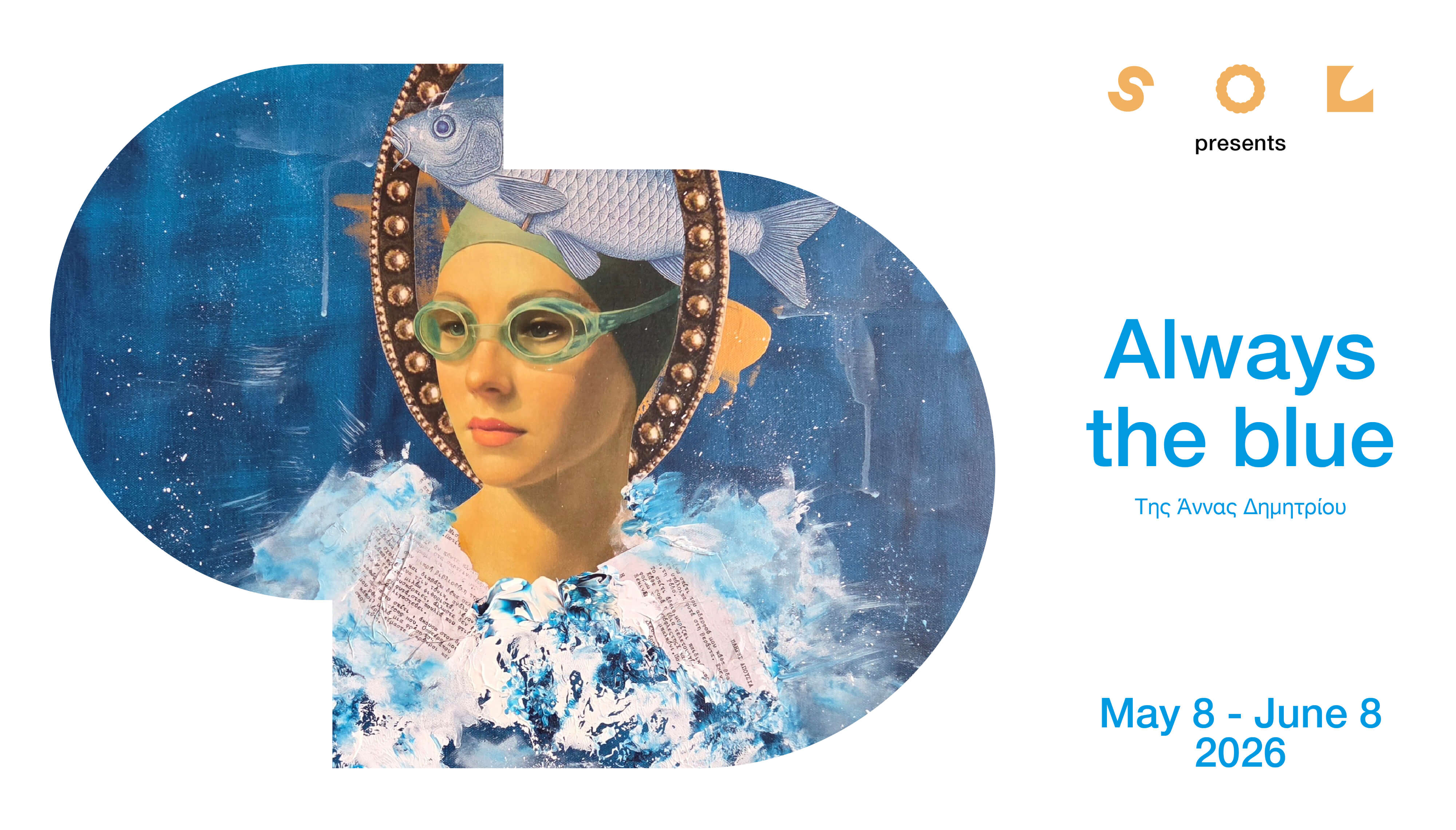
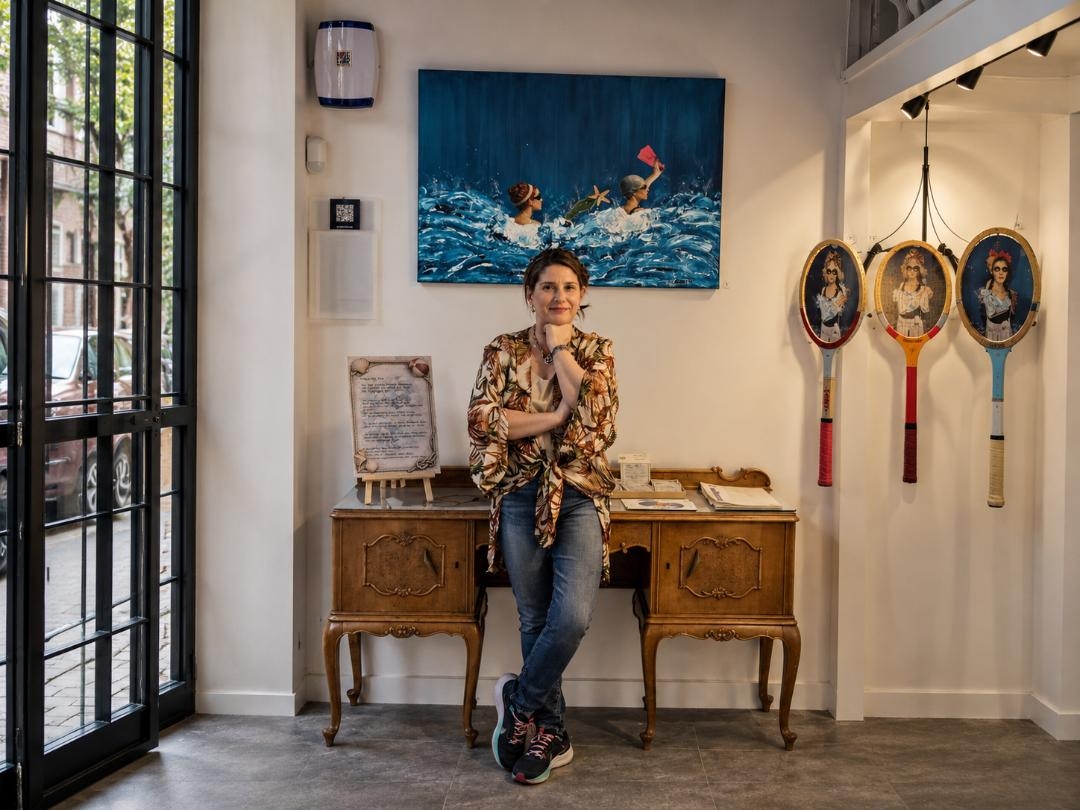
In “Always the Blue,” artist Anna Dimitriou explores summer not as a season, but as an inherited emotional landscape shaped by memory, absence, and collective experience.
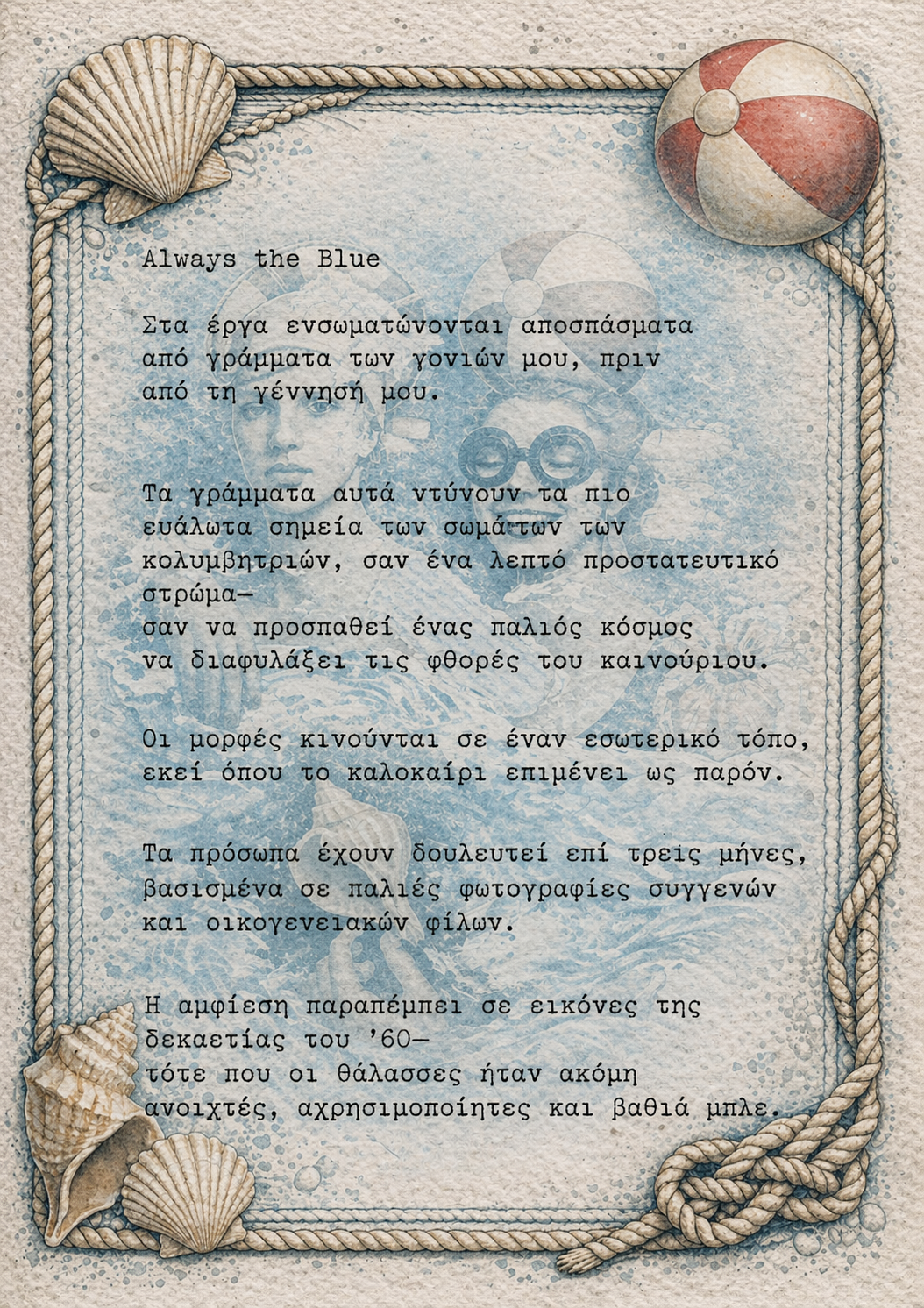
Through collage, mixed media, and installation, Dimitriou reconstructs fragments of childhood summers, swimmers, faded objects, handwritten traces, and sea-worn textures into poetic spaces suspended between reality and imagination.
For the artist, blue becomes more than color, it transforms into atmosphere, silence, longing, and emotional architecture.
Moving between nostalgia and quiet mourning, the works examine how memory survives after the world that produced it has changed, inviting viewers into a fluid territory where beauty, loss, and remembrance continuously coexist.
Your exhibition “Always the Blue” begins with the idea of “summer as inheritance.” What does this inherited summer represent for you personally, and how does it translate into your visual language?
For me, summer is not a season. It is a psychological landscape inherited through memory, family stories, gestures, objects, and absences. I grew up surrounded by images of Greek summers that carried both freedom and melancholy, sea light, faded fabrics, old photographs, the feeling of time slowing down.
In “Always the Blue,” this inherited summer becomes fragmented and reconstructed through collage, mixed media, and installation. I use swimmers, lifebuoys, beach objects, letters, and textures almost like emotional fossils. They are not nostalgic decorations; they are traces of a world that shaped me and continues to exist somewhere between memory and imagination.
How do you approach “blue” in your work so that it moves beyond representation into a state or experience?
Blue, for me, is emotional rather than descriptive. It is not simply the color of the sea or the sky. It functions as atmosphere, silence, distance, longing, protection, and sometimes even grief.
I am interested in blue as a mental state, something immersive that surrounds the viewer psychologically. In the exhibition, blue becomes almost architectural. It absorbs the figures, dissolves the boundaries between body and environment, and creates a space where memory can float freely.
The exhibition evokes childhood summers and a world that feels both real and lost. How do your personal memories and family traces shape the fragmented narratives in your collages and mixed media works?
My work is deeply connected to fragments of personal and collective memory. I often use imagery inspired by family archives, vintage aesthetics, handwritten letters, forgotten objects, and details that carry emotional weight.
The fragmented structure of collage reflects the way memory itself operates. We never remember things completely. We reconstruct them through sensations, partial images, and emotional associations. In many ways, my works function like reconstructed memories rather than linear narratives.
“The swimmers in your work do not swim in the sea, but in the waters of memory.” What led you to replace the physical sea with memory as a space of movement?
Because memory can behave like water. It carries us, distorts things, preserves fragments, and sometimes pulls us under unexpectedly.
The sea in my work gradually stopped being a physical place and became an emotional territory. The swimmers are suspended between past and present, between innocence and awareness. They move inside remembrance rather than geography.
There is a strong sense of a world that has changed — climatically, ethically, and experientially. How consciously do you engage with this loss or transformation in your artistic process?
Very consciously, although not in a directly political or illustrative way. I am interested in the quiet disappearance of emotional worlds, not only environmental loss, but also the disappearance of slowness, intimacy, mystery, and human presence.
Many of the summers represented in the exhibition feel impossible today. There is a subtle mourning inside the work. At the same time, I try not to create pure nostalgia. I am more interested in examining what remains alive inside memory after reality has changed.
Your figures seem suspended between “then and now,” caught in continuous return. Do you see this repetition as comfort, resistance, or something more ambiguous?
I think it is something more ambiguous. Repetition can be comforting, but it can also reveal unresolved longing.
My figures return constantly because memory itself returns constantly. Certain emotional landscapes repeat throughout life in different forms. The works exist in that unstable space where beauty and loss coexist.
The exhibition suggests that this remembered world continues to exist only through memory. What role do you believe art plays in preserving, reshaping, or even questioning collective memory today?
Art does not preserve memory in a documentary sense. It transforms it.
I believe art can create emotional access to collective memory by allowing viewers to project their own experiences into the work. A remembered world survives not because it is accurately archived, but because it continues to be emotionally reactivated.
At the same time, art can question nostalgia itself. Memory is never innocent or fixed. It is selective, fragile, and constantly rewritten. That instability interests me deeply.
INFO
ALWAYS THE BLUE, by Anna Dimitriou
https://www.instagram.com/canndyblue/
Exhibition curation: SOL (SLICE OF LIFE, an Elephant Design project)
https://sliceoflife.gr/exhibition/always-the-blue/
https://www.instagram.com/sol_byelephantdesign/
Hosted by: Nezer Collective Gallery
8 Nezer Street, Athens 11743
https://www.instagram.com/nezer_collective/
Exhibition duration: May 8 – June 8, 2026
Visiting Hours: Tuesday – Sunday 17:00 – 21:00, Monday closed