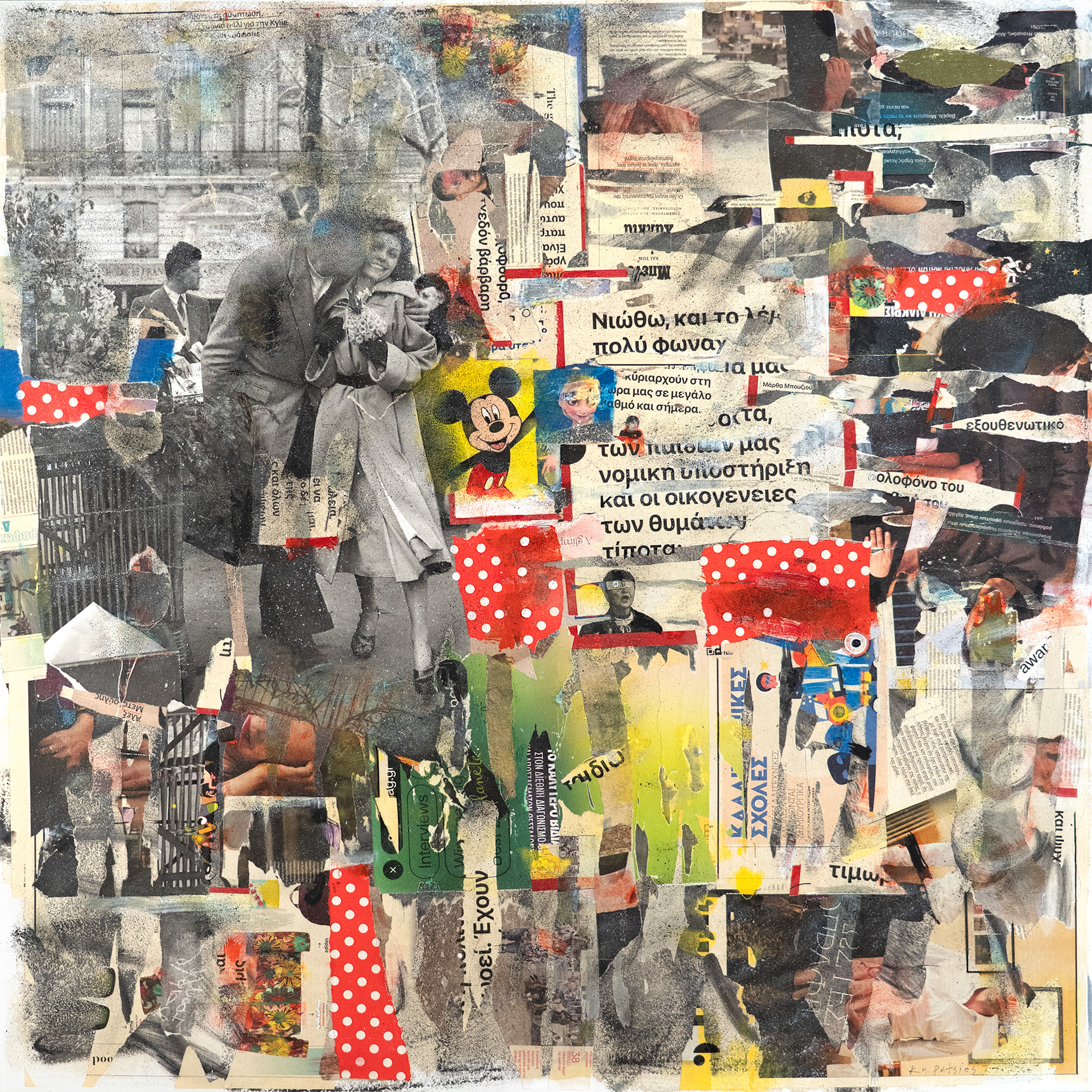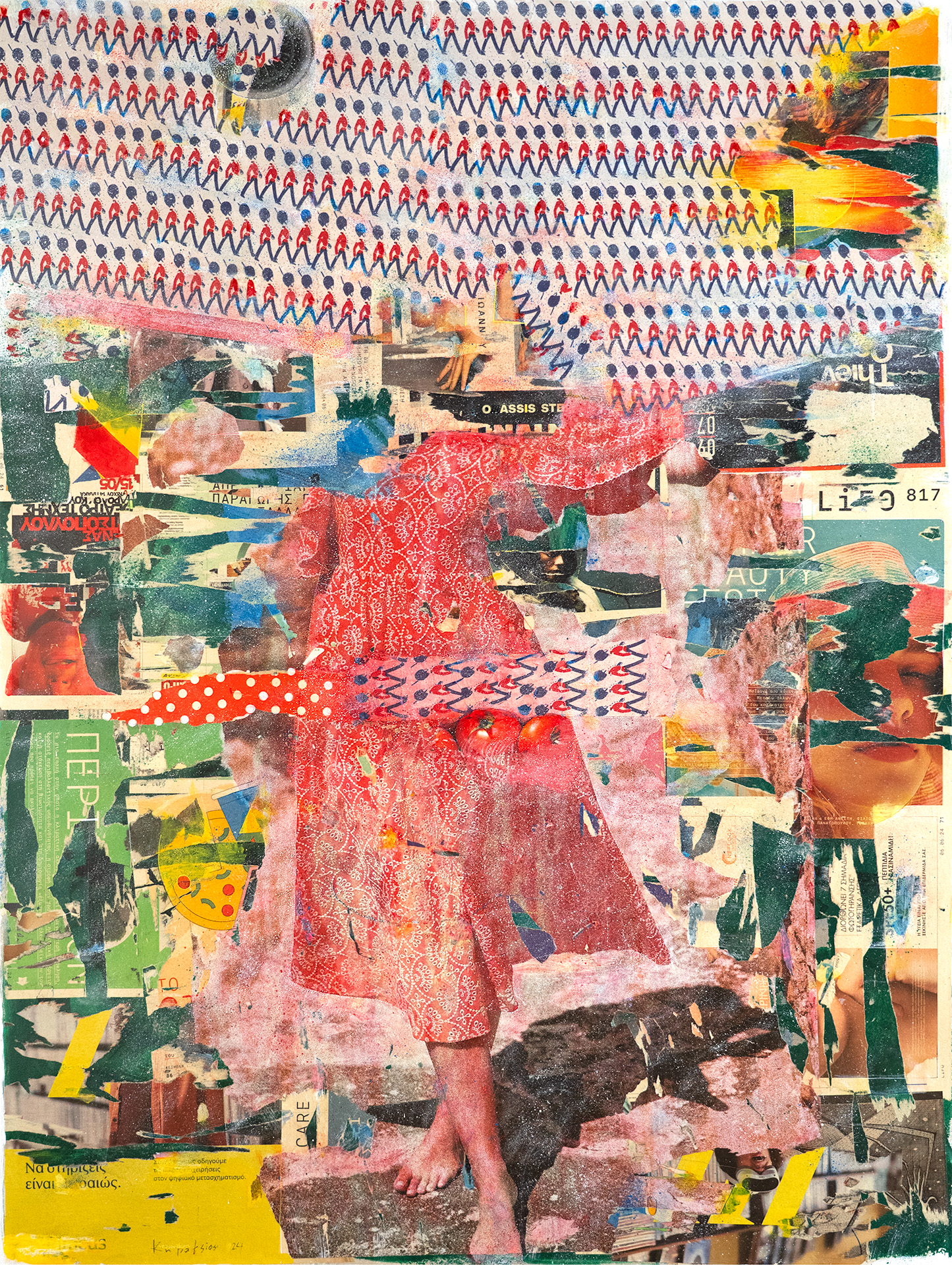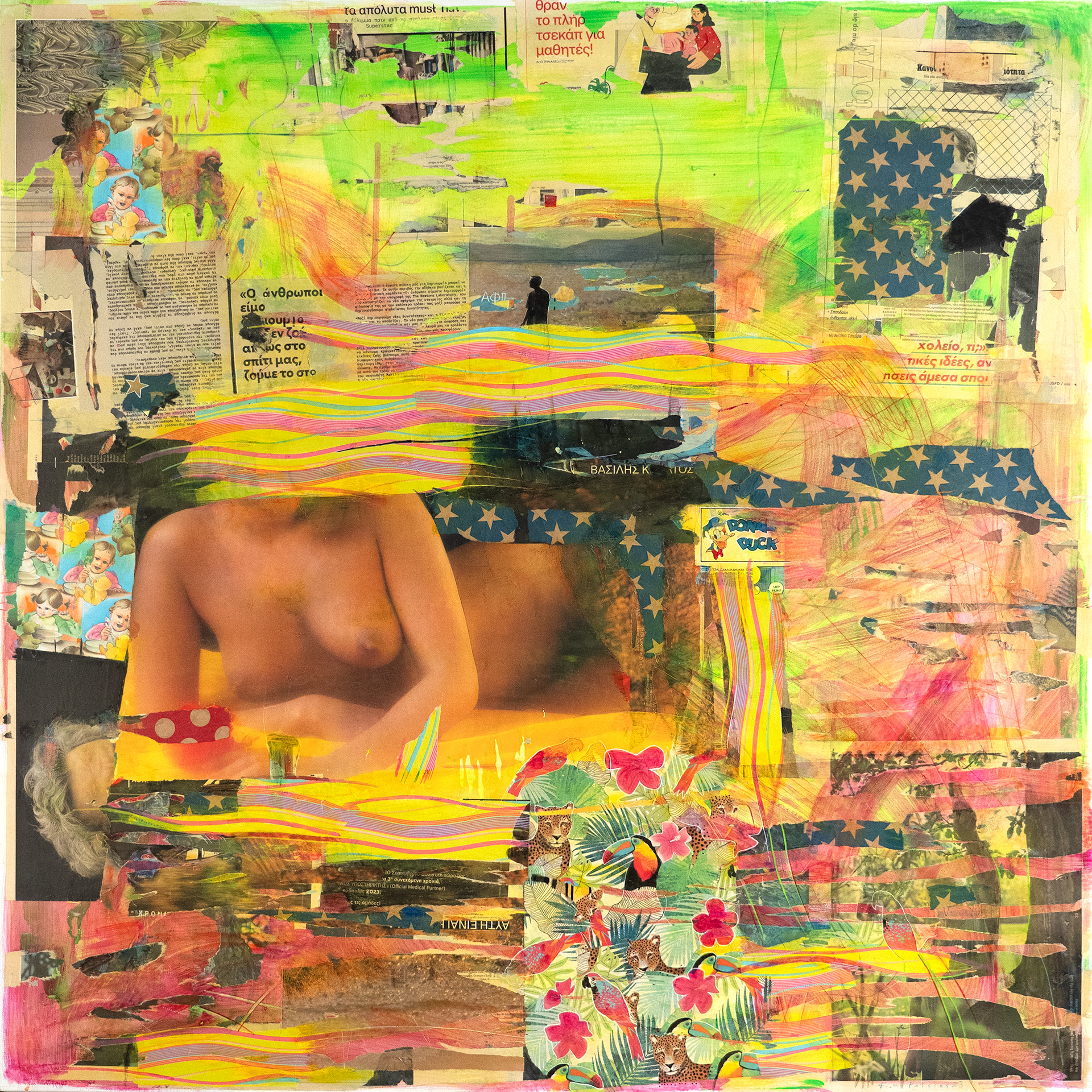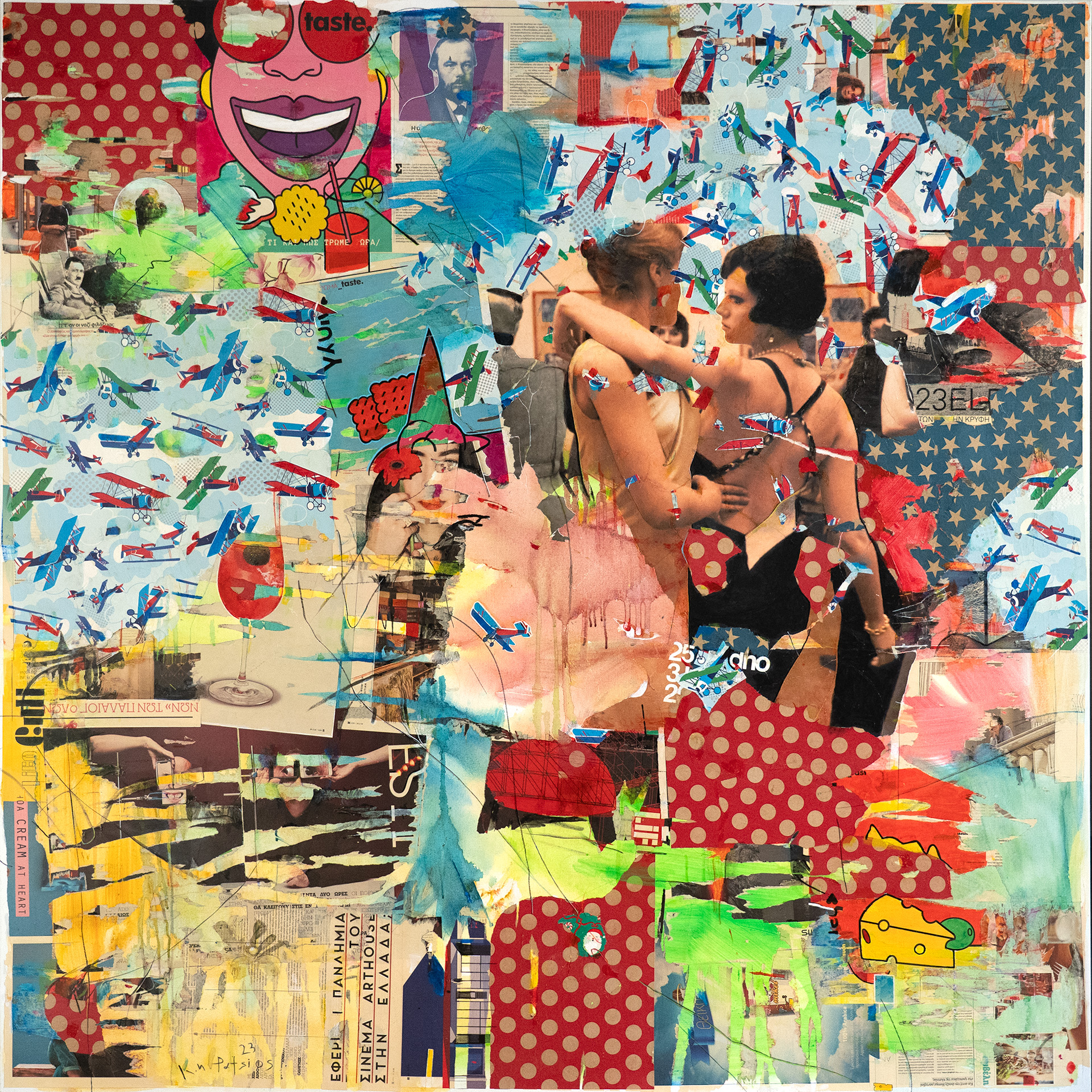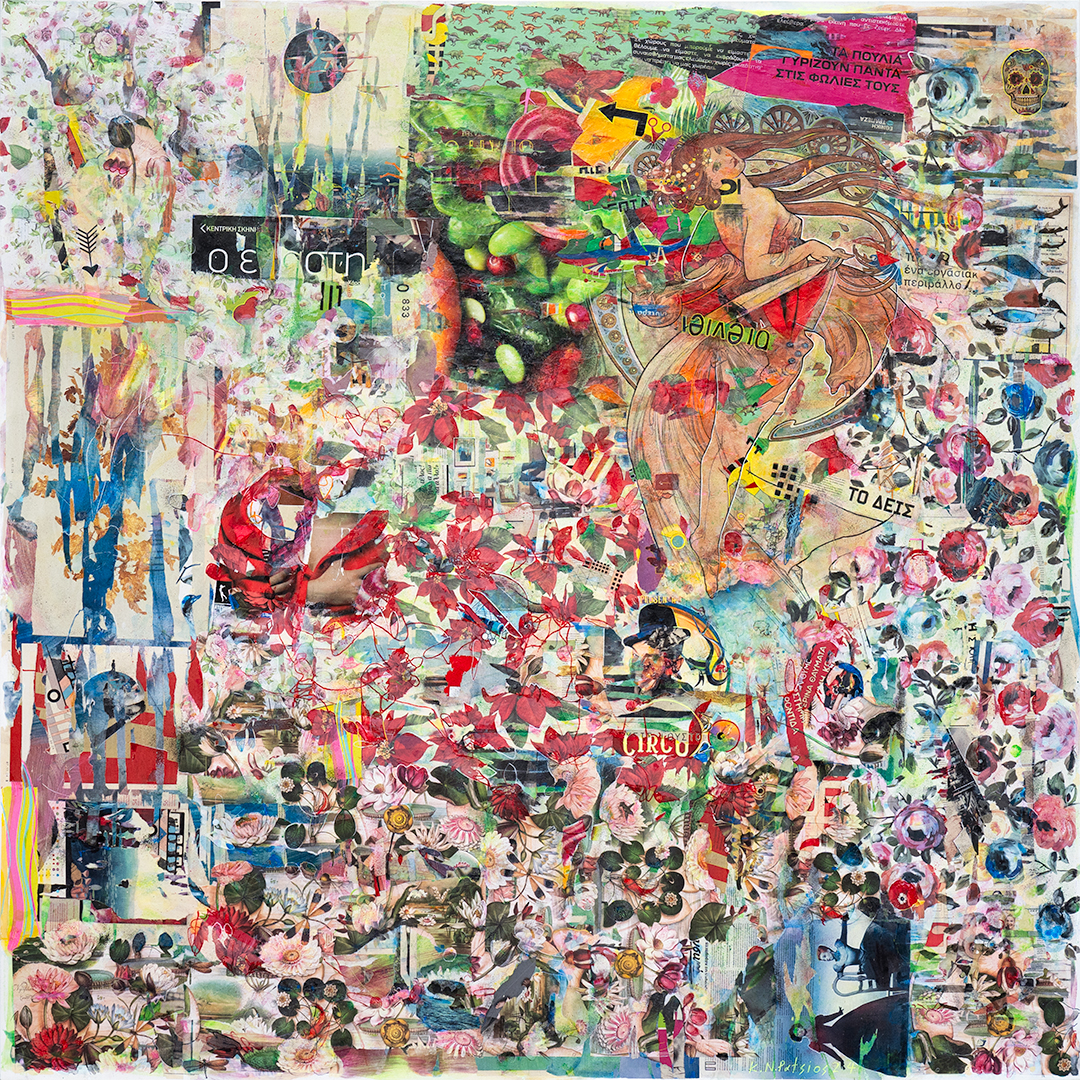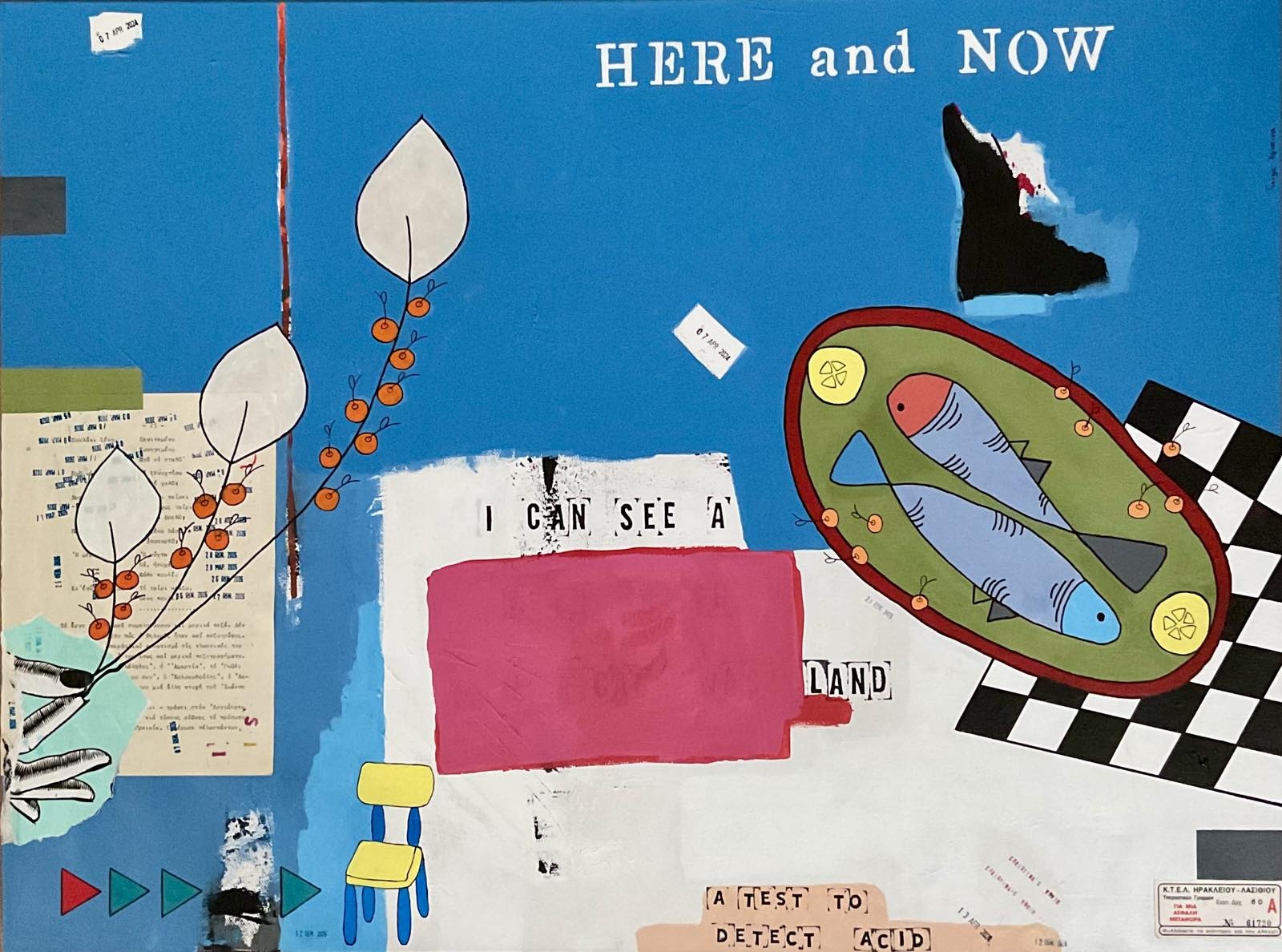

In Konstantinos Patsios’s new work, we are once again invited to explore the bustling universe that the artist creates each time, using his familiar combination of media: collage and painting.
A barrage of images unfolds on the canvas. Images that, although they initially appear unrelated to one another, ultimately serve as carriers of multiple, often suggestive meanings that the viewer is called upon to decode.
The artist’s intention, however, is not to impose a specific interpretation but to leave room for chance, for free associations, and for the personal readings generated by the encounter with the work. If, nevertheless, the viewer seeks a possible starting point for interpreting the works, then this can be found in the exhibition’s title, Woke on the Wild Side, which refers directly to Lou Reed’s iconic song “Walk on the Wild Side.” This reference triggers a whole cultural and social association around marginality, identity, provocation, and the fluidity of social roles.
Just as in the song, so too in Patsios’s works, the viewer navigates a landscape of contrasts, where the familiar coexists with the paradoxical and satire with political edge.
The coexistence of disparate images is a key element of the artist’s visual language. Meaning is not organized through a linear narrative, but emerges in fragments, through the clash and convergence of different visual codes.
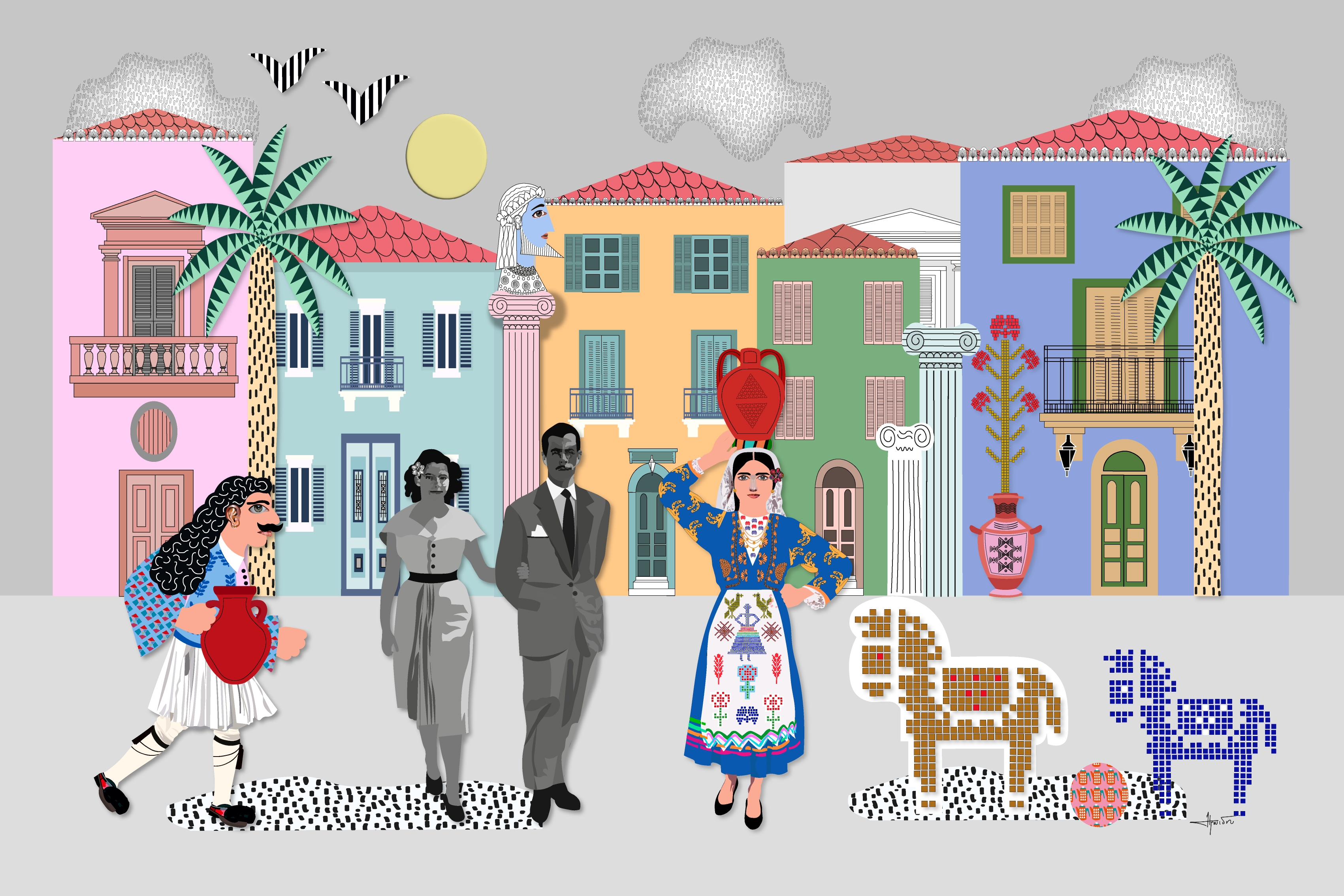
The works bring together elements from classical painting, pop culture, mass media, and advertising, creating an environment of visual overload that reflects contemporary reality. Irony and the deconstruction of symbols are pervasive in the work.
Faces are smudged, altered by the superimposition of other elements, or even mutilated. Through this process, the collage acquires not only an aesthetic but also a political dimension.
The interventions on the images, combined with fragments of words, slogans, and recognizable symbols, create a delirious and deeply timely commentary on contemporary reality.
The influence of pop aesthetics and the postwar practices of New Realism is reinterpreted through the artist’s distinctive personal style, in which the image functions simultaneously as a vehicle for memory, consumption, and ideology.
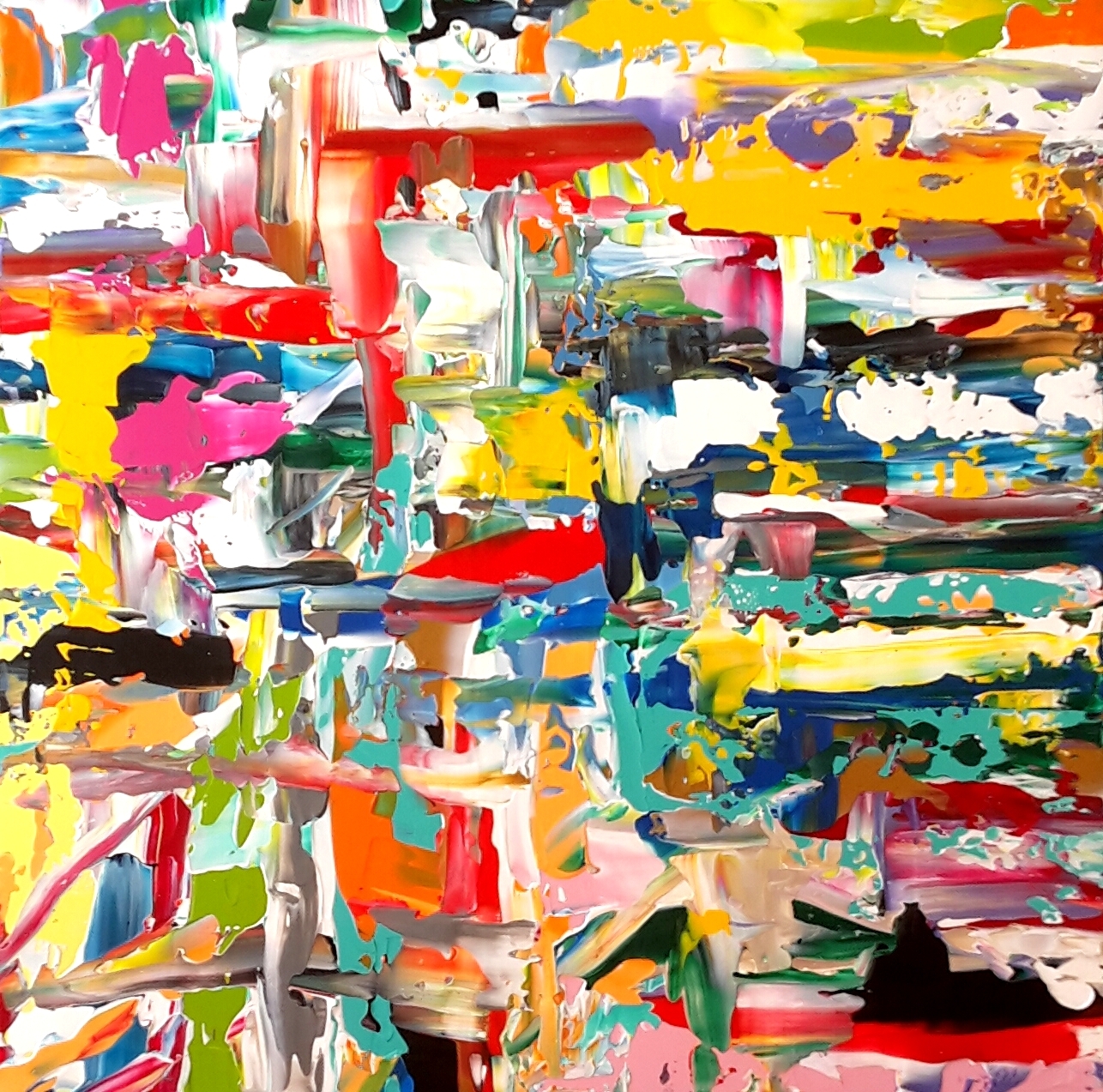
At the same time, the painting dynamically intervenes in these elements, transforming them and giving them new intensity. The chromatic contrasts and gestural brushstrokes do not serve a decorative purpose, but rather intensify the conflict
between the images, creating an effect that leaves the viewer deeply engaged. Through this technique, the artist succeeds in visually rendering the complexity of contemporary reality, where politics and mass culture coexist and clash.
On a deeper level of interpretation, one can also discern an underlying activation of the male/female dichotomy as a fluid mechanism of identity and gaze. In an almost Godardian logic of deconstruction of images and roles, as one encounters it in the cinema of Jean-Luc Godard, gender ceases to function as a fixed signifier and is transformed into a field of tension, displacement, and staged discontinuity.
The masculine and the feminine are recycled within the same visual framework, just like the cultural references that constitute the work. At the same time, the term “woke,” incorporated into the title, functions not only as an ironic or referential gesture toward the contemporary cultural condition but also as an indication of a new ethico-political vigilance that often produces its own systems of normalization of images and discourses.
In this context, the work appears to engage critically with both the rhetoric of awareness and the tensions it generates, highlighting how even the most progressive narratives can be transformed into new fields of ideological negotiation.
In this body of work by Konstantinos Patsios, a playful dynamic prevails in which everything seems to be deconstructed and reconstructed anew.
Power slips through images, words, and symbols, while irony and the play with references highlight the fragility of reality and the constant shifting of meanings. In this way, the works function as open fields of interpretation, within which politics, mass culture, and collective memory coexist and constantly clash, without ever settling on a single, definitive interpretation. The viewer is invited to navigate among fragments of images and symbols, to construct their own paths, and to renegotiate their relationship with what they see.
Thus, these works do not offer easy answers, but rather present an open challenge to understanding contemporary reality and the mechanisms that shape it.
Venia Pastaka – Art Historian
Biography
Konstantinos Patsios was born in Athens in 1977. He studied Economics at the University of Piraeus and at the Grande École de Commerce de Poitiers in France. He received a scholarship to the Rhode Island School of Design (RISD) in Providence, U.S.A. He then studied Painting at the Athens School of Fine Arts under G. Psychopedis and M. Spiliopoulos, and Sculpture under N. Tranos. He has held nineteen solo exhibitions in Greece and abroad and has participated in numerous group exhibitions.
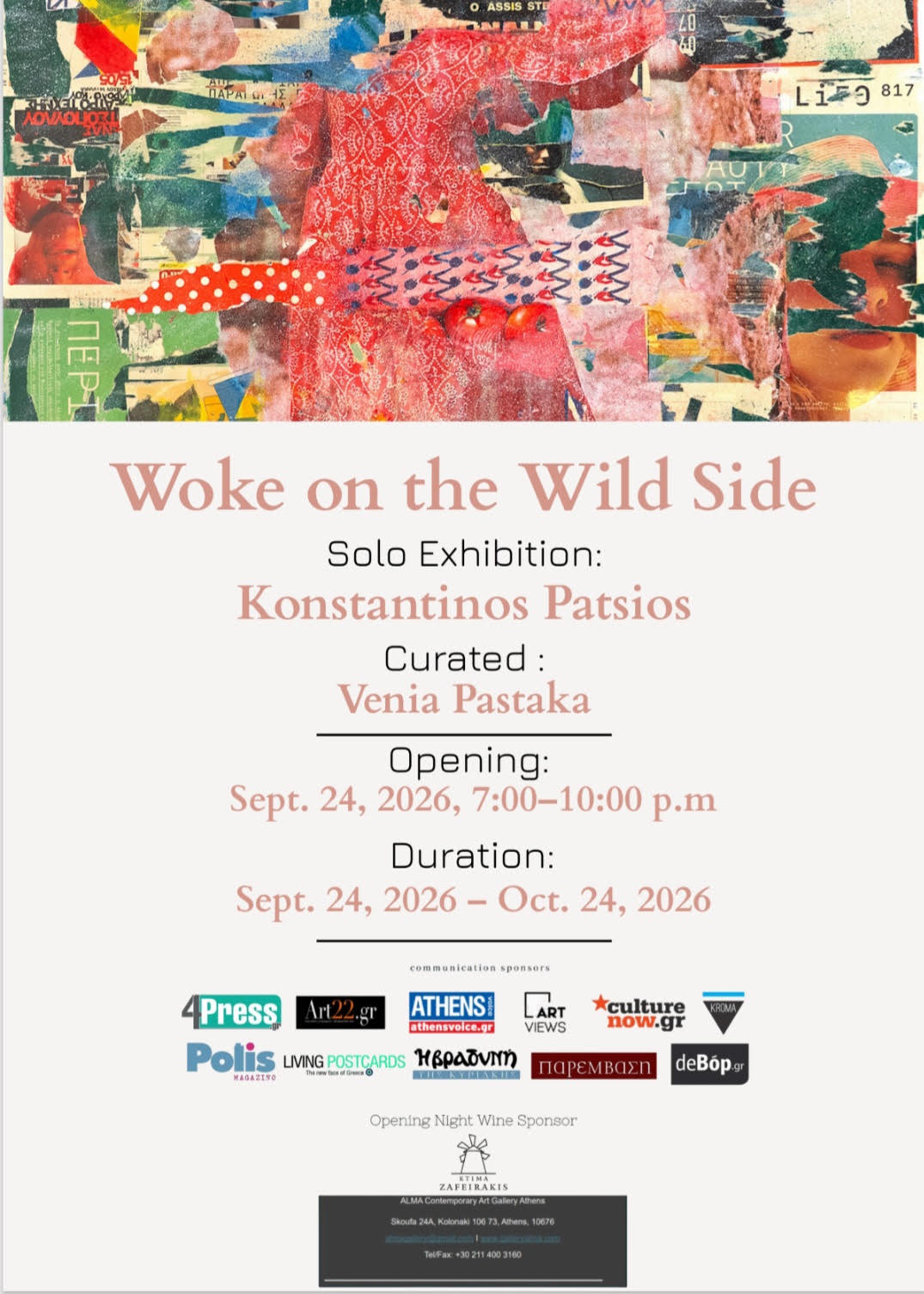
Woke on the Wild Side
Konstantinos Patsios
Curated by: Venia Pastaka
Opening: September 24, 2026, 7:00–10:00 p.m., 24A Skoufa Street, Kolonaki
Duration: September 24, 2026 – October 24, 2026
Hours: Tuesday–Thursday–Friday 11:00 AM–8:00 PM, Wednesday & Saturday 11:00 AM–3:00 PM
ALMA
Contemporary Art Gallery
Managing Director : Nikolas Almpanis
Art Director : Almpani Maria
Skoufa 24A, Kolonaki - Athens 106 73 Greece
T. +30 211 400 3160
F. +30 211 400 3160
M. +30 693 680 7660
&
Karanasiou 13 - Trikala 42100 Greece
T. +30 24310 74586
F. +30 24310 74586
M.+30 697 77 15 842