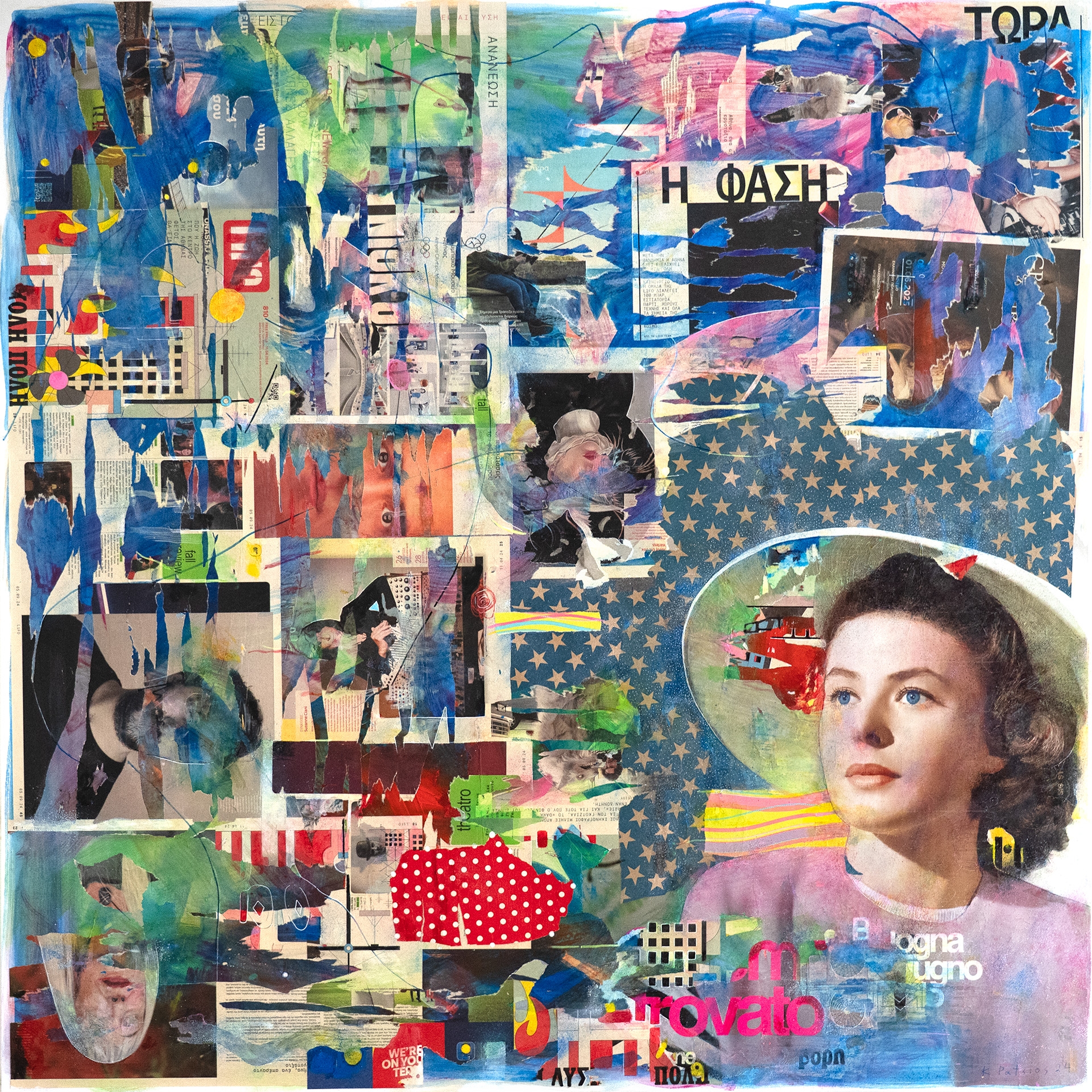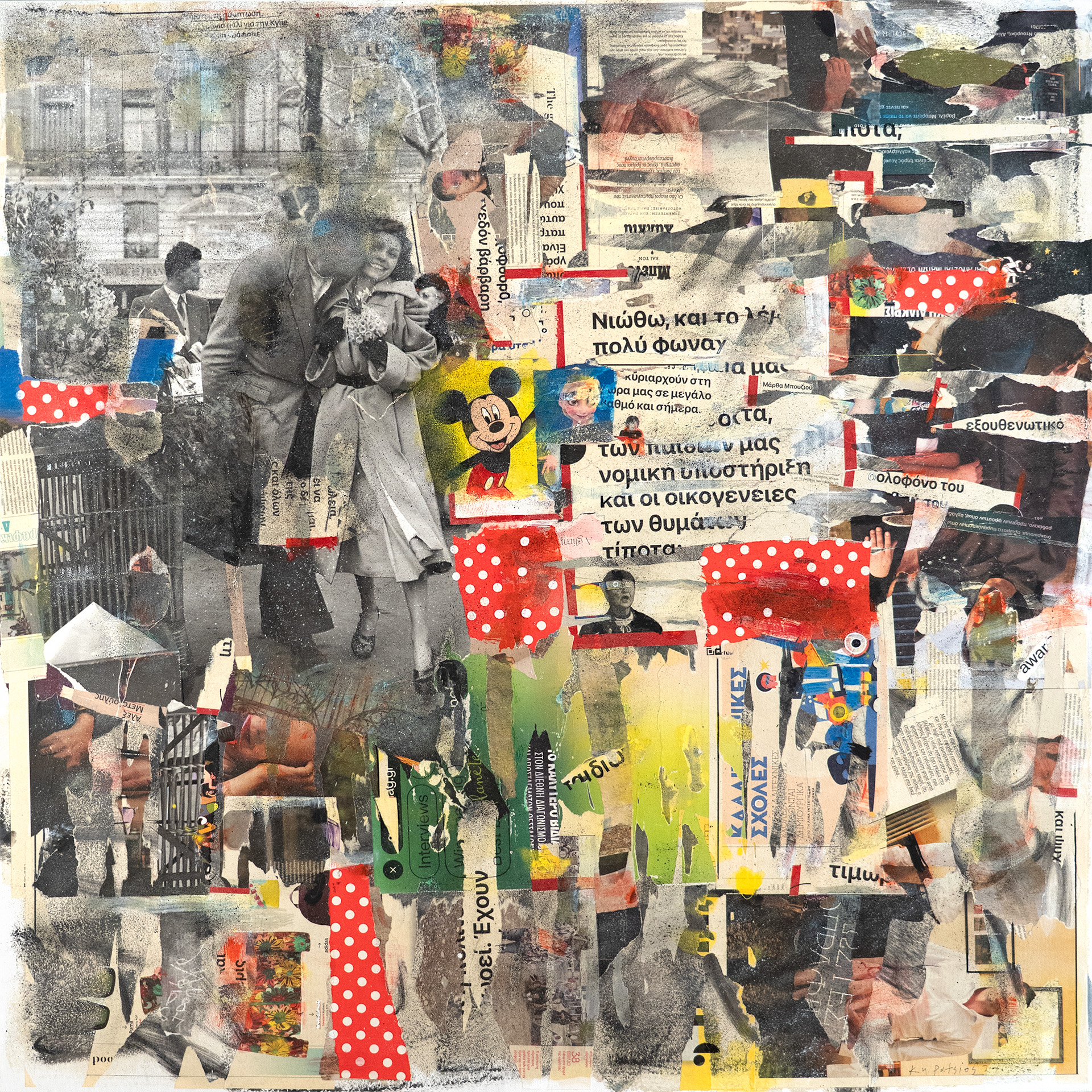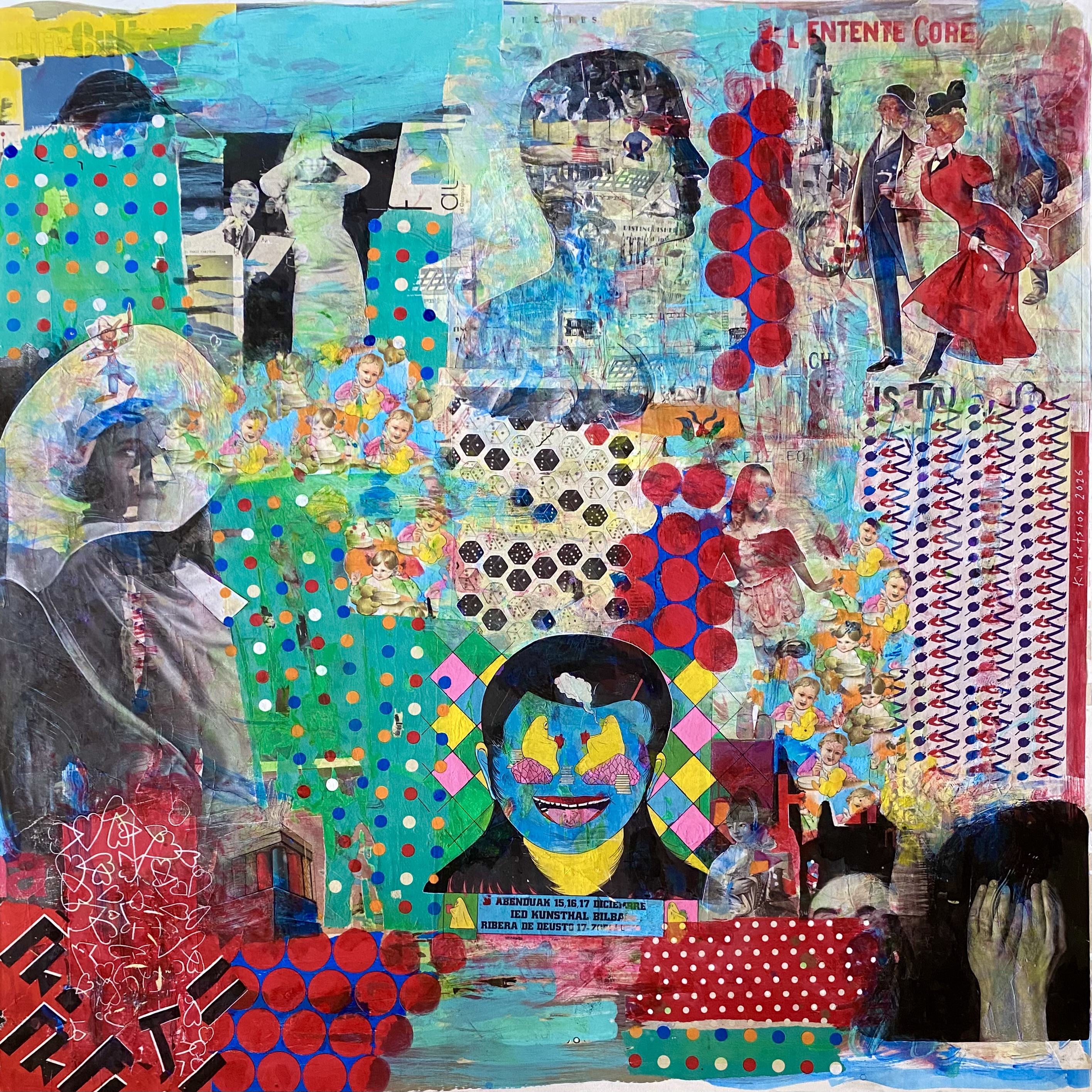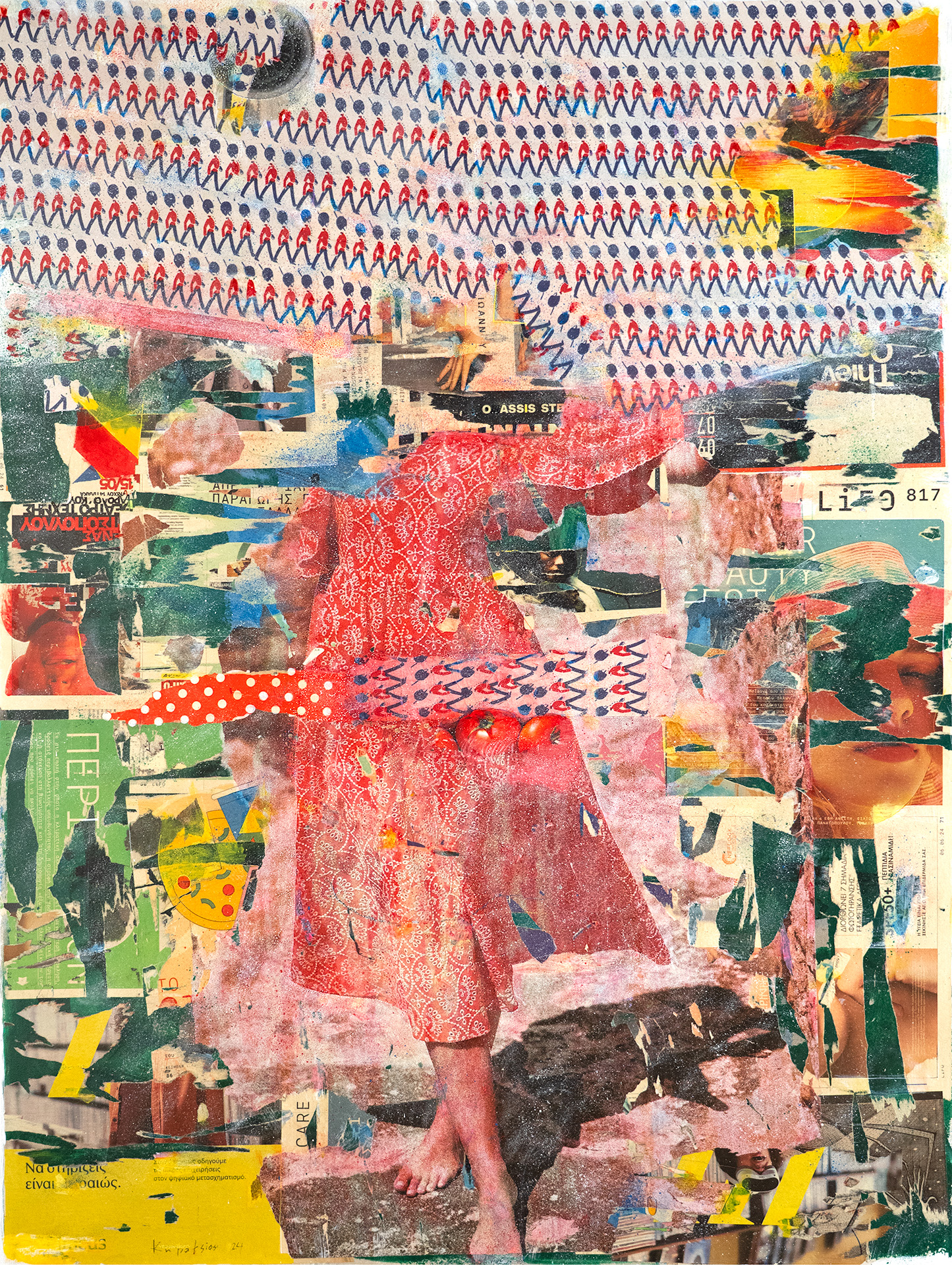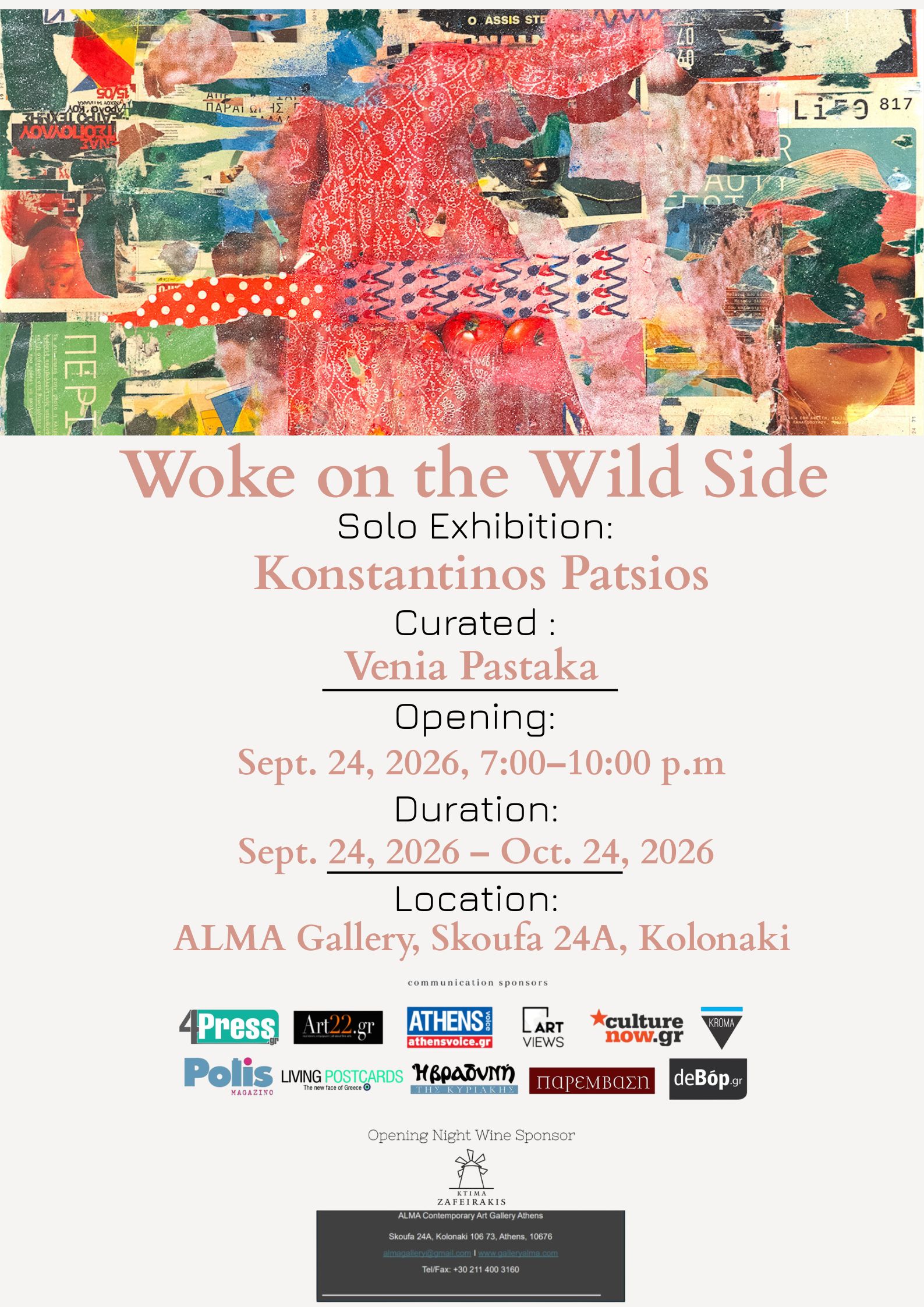
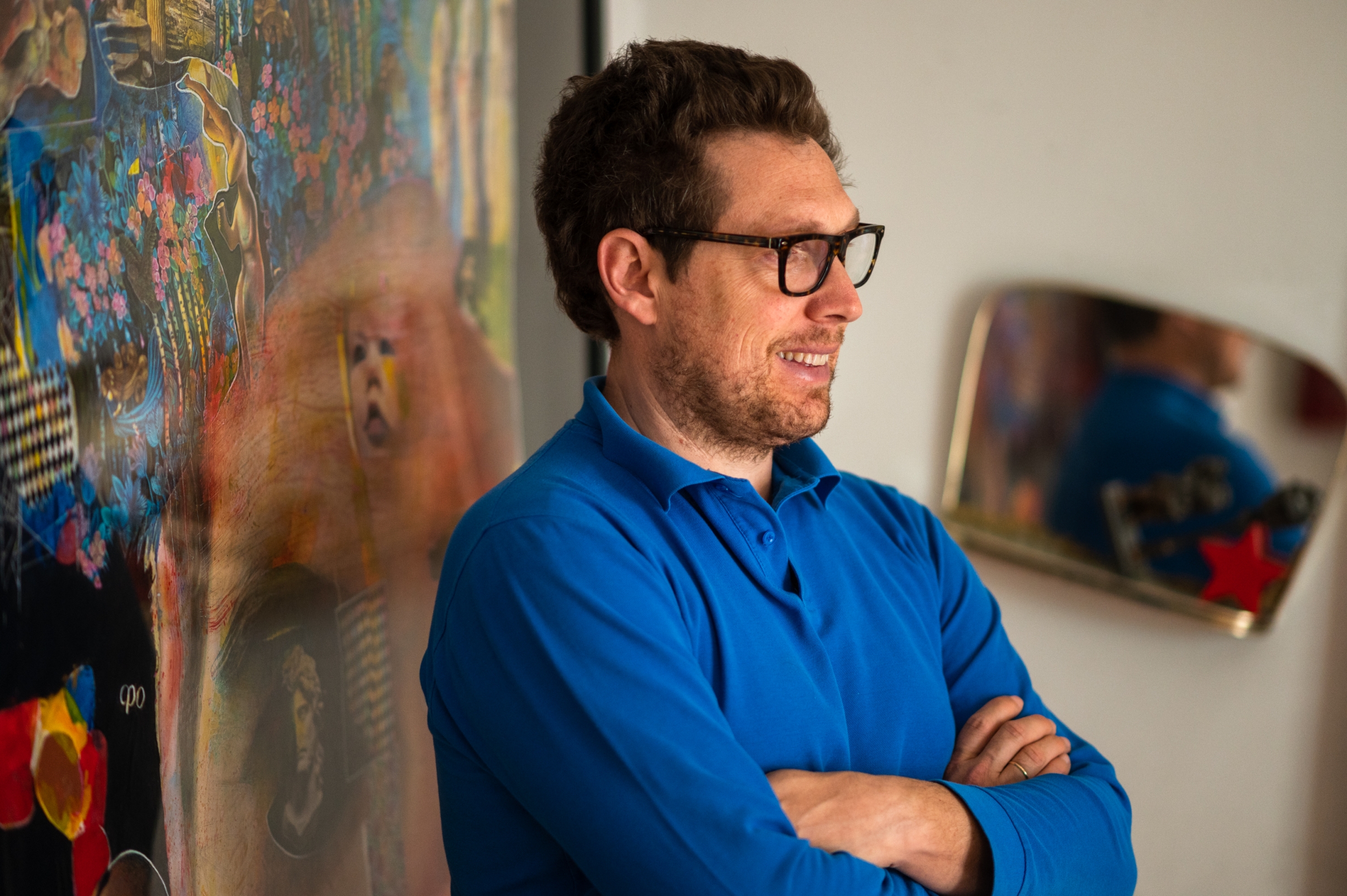
In Woke on the Wild Side, Konstantinos Patsios brings together collage, painting, symbolism and cultural references to explore identity, contradiction and the complexities of contemporary life.
In this conversation, he reflects on his unconventional journey to art, the evolution of his visual language, and his belief in art as a space for questions rather than answers.
Playful, provocative and philosophical, his work invites us to pause, look again, and embrace the uncertainty within the image.
Your path to art wasn't linear, you first studied Economics before committing fully to artistic practice. Looking back, do you see that shift as a conscious decision, or as something that gradually became inevitable?
At eighteen, I certainly did not have a clear sense of who I was or what I wanted to devote my life to. I came from a family with a strong commercial background, so studying Economics seemed like a natural and, in a way, sensible choice. I remember my father telling me the familiar Latin phrase primus vivere, deinde philosophari, first make a living, then philosophize. His advice was essentially to choose something that could provide me with a livelihood and, afterwards, to discover what might truly satisfy the soul.
Of course, things did not quite unfold that way. Art is not simply an occupation that you choose; once it enters your life, it gradually takes possession of you. It becomes a way of living, a way of looking, and eventually a way of understanding the world.
Looking back, I would say that the decision to study Economics was conscious, but the decision to become an artist was not entirely so. I tend to believe that you do not simply choose art — in some sense, art chooses you. What you can choose consciously is the framework of your education, the disciplines you study, the experiences you pursue. But the deeper impulse toward artistic creation often comes from somewhere less rational, something that reveals itself gradually and becomes increasingly difficult to ignore.
Perhaps this is why I do not see my early studies as something completely separate from my artistic journey. They belong to the same path, even if I could not recognize it at the time. Sometimes we understand the meaning of our earlier choices only in retrospect.
Your work inhabits a space where collage, painting, art history and contemporary visual culture collide. How did this visual language evolve, and at what point did you recognize it as distinctly your own?
It is true that an important part of my practice revolves around collage, décollage and painting, while art history is present throughout the work, often through conceptual and visual references. In many ways, I see my practice as an evolution of what Marcel Duchamp described through the idea of the readymade, particularly the possibility of taking something that already exists and transforming its meaning through artistic intervention.
I often begin with existing images, objects or fragments of visual culture and subject them to a process of alteration, sometimes partially, sometimes almost completely. Through this process, the familiar becomes unfamiliar. Something is removed, displaced, reconstructed or placed in a new context, allowing another meaning to emerge.
The techniques and strategies I use have their roots in a long artistic lineage, from Dada and Surrealism to Conceptual Art, but they are always in dialogue with the great tradition of painting and with those larger narratives through which artists have attempted to interpret the human psyche. I am interested in this coexistence of the historical and the contemporary: the accumulated memory of images on the one hand, and the constantly changing visual environment of our own time on the other.
I recognize something distinctly mine in the way I work, but I do not see originality as a complete separation from what came before. On the contrary, I believe that every artist carries within their work a kind of accumulated knowledge, consciously or unconsciously absorbed from previous generations of artists. What becomes personal is the way this knowledge is processed, transformed and ultimately reassembled.
The personal element in my work did not emerge as an objective in itself. It developed gradually, through years of work, experimentation, failures, discoveries and repetition. At some point, without deliberately seeking it, a personal language begins to appear. You recognize it not because you have invented something entirely new, but because you realize that the way you combine, transform and look at things could only have come from your own experience.
We live in an era defined by relentless image production and accelerated ways of seeing. Does your practice mirror this visual overload, or does it seek to interrupt it, creating space for slower and more attentive looking?
We certainly live in an age of constant visual “zapping”, an uninterrupted circulation of images, information and stimuli. We move from one image to another almost instinctively, often before we have had the chance to truly look at what we are seeing. In this sense, the image has lost some of the sacredness and contemplative power it possessed in other historical periods.
My work does, to a certain extent, embrace this condition. The compositions contain a certain maximalism, fragmentation and impulse toward deconstruction. They reflect the visual excess of our time. At the same time, however, there is an opposing impulse within them: an attempt to gather, control and reshape this flow.
My compositions often begin with a fragment of chaos. The challenge is then to organize that chaos and transform it into an image that can be perceived as a meaningful whole. I am interested in the tension between these two forces — fragmentation and structure, noise and silence, excess and restraint.
In this sense, I would not say that my work simply seeks to escape visual overload. Rather, it enters into dialogue with it. I take fragments from this accelerated visual world and try to slow them down, to give them another kind of duration and another possibility of being read.
The images that emerge are, in a sense, propositions born out of chaos and silence. They attempt to become coherent without ever becoming completely stable. There is often a certain fragility in them — a precarious balance between the fragments that constitute them. Perhaps this fragility also reflects something about the contemporary human condition: our attempt to construct meaning and coherence while living within an environment that is constantly being fragmented and reconfigured.
Ultimately, I am interested in whether an image can still make us stop. Whether, amid the endless stream of images, it can create a small interval of silence, a moment in which we do not simply see, but actually look.
Your compositions resist fixed narratives, leaving meaning deliberately open. What role does ambiguity play in your practice, and are you interested in relinquishing authorship once a work enters the public sphere?
I am not sure that my compositions are necessarily “open” in the conventional sense. I think this question touches more broadly on the nature of the image, on symbols, and on the way an artist uses them.
I certainly do not want to tell the viewer one specific thing. I am more interested in showing many things at once, allowing different associations and meanings to coexist within the same image. My work is not journalism. It is not there to deliver a precise message or to report on reality. Its purpose is to create new points of visual perception and, perhaps, new points of cultural reference.
My aesthetic and the way I construct my compositions have certainly been influenced by Wittgenstein and by his understanding of language, meaning and the limits of what can be said. At times, the message itself is not what interests me. I may even prefer confusion. There is something productive in not fully understanding, in allowing an image to remain unresolved. As Sonic Youth put it so beautifully: “Confusion Is Sex.” I like that tension between meaning and its disruption.
Once a work enters the public sphere, I do believe it begins to have a life of its own. In that sense, authorship inevitably becomes less absolute. The artist creates the conditions, constructs the image and sets certain things in motion, but the viewer completes the experience through their own history, associations and sensitivities.
Perhaps this is where visual art has something in common with poetry. Once a poem is released into the world, it no longer belongs exclusively to the person who wrote it. Each reader experiences it differently. I think the same can happen with an image: its meaning is not necessarily something fixed that the artist hands over to the viewer, but something that can continue to unfold.
Humour, irony and cultural critique often operate simultaneously in your work. Do you see art as a space for political engagement, or are you more interested in exposing contradictions than offering positions or conclusions?
I am interested in all of these things. I want my work to register certain truths about society and about the human condition, and to reveal the contradictions that shape the political systems we live within.
So, yes, I want my art to have a political voice, but always with the human being at its centre. I see art as a kind of mirror of my own soul, but that soul does not exist in isolation; it participates in society, in history, in politics and in the ethical questions of its time. It would therefore be impossible for the content of my work not to engage, in one way or another, with what we call ethics.
At the same time, I do not think that art needs to offer political solutions or arrive at definitive conclusions. I am more interested in exposing contradictions, tensions and absurdities, and allowing them to remain visible. Humour and irony are particularly powerful in this respect. They can create a distance from what is painful or unbearable, while at the same time making it even more visible.
All of this, however, has to happen through the language of visual art. An artwork is not a political essay translated into an image. It has its own grammar, its own ambiguities, its own mechanisms of seduction and resistance.
My art therefore both reflects and proposes. It reflects the world as I experience it, while proposing another way of seeing it. The viewer is then invited to enter that space and discover, or construct, the meaning of the work for themselves.
The exhibition title, Woke on the Wild Side, is immediately provocative, playful and layered with cultural references. How did it emerge, and what kind of conversation did you want it to initiate?
It is all of these things — provocative, playful, ironic and layered — much like the art itself.
Woke on the Wild Side comes from a song I love, and in a way it functions as a kind of soundtrack to many of the works in the exhibition. The title emerged because this series explores the relationship between the masculine and the feminine in the contemporary world, but it is not simply a reference to what is usually described as the “woke agenda.”
I am more interested in the broader question of how distinct individuals, genders, cultures and ethnicities coexist in the contemporary world. How do we negotiate difference? How do we live alongside one another without constantly turning difference into conflict?
The word “woke” also interests me in a more literal and fundamental sense. Art can be a form of awakening. It can bring to the surface images, thoughts and experiences that are often silenced, overlooked or suppressed in everyday life. It can make us see something that was already there but that we had stopped noticing.
And then there is humour and irony. For me, these are not simply decorative elements or ways of making the work lighter. They are tools for dealing with the drama and darkness of the human condition. Sometimes irony allows us to approach something unbearable more directly than seriousness can.
The exhibition also exists within a world of recurring and shifting wars, conflicts and divisions , a world in which humanity still seems unable to coexist in a more harmonious way. In that sense, the title contains a certain contradiction: an awakening taking place in a wild, unstable and often violent age.
Woke on the Wild Side is therefore both playful and serious. It is an invitation to wake up , but on the wild side.
Questions of identity, gender and the instability of cultural symbols run throughout the exhibition. Do these concerns represent a departure in your practice, or have they always existed beneath the surface, only becoming more visible now?
My work has always been rich in symbolism. I understand art as a question, as an attempt to create a new image through which we can ask what an image of the human being might actually be.
These concerns are therefore not a departure from my practice. Symbols have been present in my work for many years, sometimes in much more raw, direct or even violent forms. What may have changed is not necessarily the subject itself, but the way in which it has gradually become more visible and more concentrated.
I believe that the artist is constantly trying to rediscover what the image of the human being is. In order to do that, we inevitably have to confront and sometimes collide with the images that have been inherited from the past — the established representations of gender, identity, beauty, power, sexuality and culture.
This conflict with older images is important to me. A new image does not simply appear from nowhere; it emerges through a confrontation with the images that already exist.
Symbolism has always interested me because it is an extraordinarily powerful tool for creating images with a greater density of meaning. A single symbol can carry layers of historical, cultural, psychological and personal associations. I am interested in that density, in the possibility that an image can remain visually immediate while opening much deeper fields of interpretation.
Exhibitions often function as encounters rather than statements. What kind of experience do you hope visitors have when they move through Woke on the Wild Side? Is there something you hope they leave questioning, or perhaps unlearning?
First of all, I hope they are moved — in the fullest sense of what the Greek word for emotion, synaesthesia, and its roots suggest: that something moves within them and sets something else in motion. I would like the viewer to move with me through the exhibition.
I believe that art creates questions more than it provides answers. Each person may experience something different, perhaps beyond the initial aesthetic emotion. The work may trigger a memory, an association, a discomfort, a contradiction or simply a new way of looking.
As I mentioned earlier, I consider myself, in a sense, a Wittgensteinian artist. I use the tools and possibilities of the image rather than those of another form of art or discourse. My questions therefore have to be formulated visually. The contradictions, tensions and conflicts within the work are part of its visual language.
There is also a certain polemic with the contemporary world in these works, but this does not exist outside my artistic universe. On the contrary, all these contradictions — beauty and violence, attraction and conflict, order and chaos, the personal and the political — coexist within it.
I would ultimately like the exhibition to be an interesting experience for the viewer. Not necessarily a comfortable one, and certainly not one in which everything is explained. If someone leaves with a question that they did not have when they entered, then perhaps the work has already accomplished something.
After nearly two decades of exhibiting, how has your relationship with uncertainty changed? Are there questions that continue to drive your practice, even as the answers remain elusive?
I think I remain equally certain about my uncertainties.
Perhaps this is one of the few things that has not changed. I still inhabit a solid yet chaotic universe in which human beings, twenty centuries later, continue to be born, to fall in love, to desire, to suffer and to die — and, at the same time, continue to wage war against one another in the most terrible ways.
The fundamental questions have not disappeared. If anything, the passage of time has made them more persistent. What is a human being? How do we live with one another? How do we construct meaning in a world that is simultaneously beautiful, absurd, violent and fragile?
I do not think an artist necessarily needs to resolve these questions. Perhaps the opposite is true. The role of art may be to keep certain questions alive, to give them new images and new forms, and to prevent us from becoming too comfortable with the answers we think we already have.
So uncertainty does not feel to me like a lack of direction. It is the space in which the work can continue to exist. I am, in that sense, still a resident of this paradoxical universe — certain that it is chaotic, and uncertain about almost everything within it.